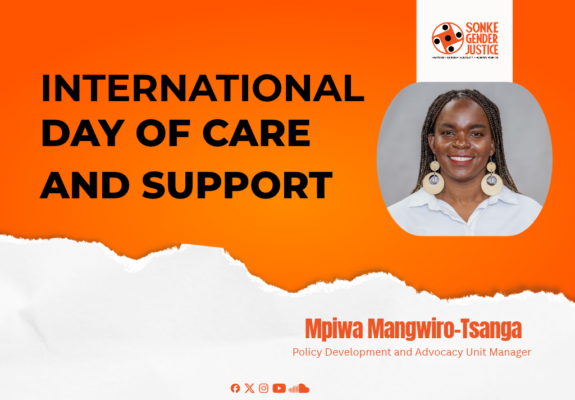
By Mpiwa Mangwiro-Tsanga
Every day, millions of women perform the work that keeps families, communities and economies running. They prepare meals, care for children, support elderly relatives, clean homes and provide the emotional labour that holds households together.
Most of this work is unpaid. Much of it is invisible. And far too much of it falls on women.
As we mark the International Day of Care and Support under the theme “Towards a Caring World”, we should confront a simple but uncomfortable truth: we cannot build a caring world while care remains largely women’s responsibility.
For all the progress made towards gender equality, the division of care inside homes has changed far more slowly than the world around it. Across Africa, women continue to spend significantly more time on unpaid care work than men. The result is visible everywhere. Women are more likely to sacrifice economic opportunities, reduce working hours or leave employment altogether because someone still needs to care for children, older family members and households. The ILO’s 2024 global estimates found that 708 million women and 40 million men were outside the labour force because of care responsibilities in 2024.
This is often described as a private matter. It is not.
Who cares, who gets paid, who advances at work and who gives up opportunities are all shaped by decisions made far beyond the home. They are shaped by social norms, workplace cultures and public policy.
At the heart of the problem is a stubborn idea that has survived generations: men provide and women care.
These expectations affect both women and men. Women carry a disproportionate share of unpaid work. Men are often denied the opportunity to develop deeper caregiving relationships with their children and families. Both are confined by outdated ideas about what their roles should be.
Care is not women’s work.
It is human work.
Yet many men are still treated as though caring for children or family members is optional, exceptional or worthy of special praise. A father attending a school meeting, changing nappies or taking parental leave should not be regarded as doing someone a favour. He should be regarded as doing his share.
For years, Sonke Gender Justice, through campaigns such as MenCare, has worked to challenge these harmful assumptions by encouraging men to play a more active and equitable role in caregiving and family life. The objective has never been to “help” women with care work. It has been to transform the belief that care belongs to women in the first place.
But changing attitudes, while essential, is not enough.
We cannot tell men to care more while maintaining systems that make caregiving difficult, costly or professionally risky.
Consider a father who wants to spend time caring for his newborn child. He wants to support his partner, attend medical appointments and be present during the critical first months of his child’s life. Yet he faces limited parental leave, financial pressures and a workplace culture that expects uninterrupted commitment to work.
His ability to care is no longer simply a matter of choice.
It becomes a question of whether society allows him to do so.
This is why conversations about care must extend beyond individual behaviour. They must also include laws, workplaces and public institutions.
If we are serious about sharing care more equally, then caregiving cannot be treated as something that happens only after work is done. It must be recognised as part of life itself.
The importance of this principle was recognised in South Africa’s landmark parental leave litigation.
In Van Wyk and Others v Minister of Employment and Labour, Sonke Gender Justice joined Werner and Ika van Wyk and the Commission for Gender Equality in challenging parental leave provisions that reinforced unequal assumptions about caregiving.
At its core, the case raised an important question: should the law continue to assume that women carry primary responsibility for caring for children while men remain primarily responsible for earning an income?
In October 2025, the Constitutional Court answered that question decisively.
The judgment declared provisions governing maternity, parental, adoption and commissioning parental leave unconstitutional because of the way they differentiated between categories of parents.
While the case focused on parental leave, its significance extends much further.
The judgment challenged the notion that caregiving is naturally women’s responsibility. It recognised that fathers need meaningful time to bond with their children, establish caregiving relationships and participate fully in family life. It also affirmed the principle that care should not be allocated according to outdated gender stereotypes.
The ruling represents an important step forward. But court victories alone will not redistribute care.
The true measure of success will be whether laws are reformed, workplaces adapt and families are able to exercise these rights without financial hardship or discrimination.
A caring society cannot be built through legislation alone.
It must also be built in homes.
That means moving beyond the idea that men are helping their partners when they cook, clean, care for children or support family members. These are not favours. They are responsibilities.
It must also be built in workplaces.
Too many organisational cultures continue to reward constant availability while treating caregiving responsibilities as an inconvenience. Yet workers do not stop being parents, partners or caregivers when they arrive at the office.
And it must be built through public investment.
Accessible childcare, healthcare, social protection and support for older persons and people living with disabilities do not simply support families. They reduce the burden of unpaid care and help create conditions for greater equality.
Importantly, greater participation by men must not become an excuse for governments and employers to retreat from their responsibilities. Care is a collective concern. Families cannot carry the burden alone.
The International Day of Care and Support should be more than a symbolic recognition of caregivers. It should be a reminder that care has always been essential work, even when it has gone unseen and undervalued.
If we genuinely want a more equal society, we must stop treating care as something women do by default.
We must reject the idea that men deserve recognition simply for showing up. We must create conditions in which caring for children, supporting partners and looking after family members are accepted and expected parts of men’s lives.
The question is no longer whether men have a role in care.
They do.
The question is whether we are prepared to challenge the norms, institutions and systems that continue to place the responsibility for care primarily on women.
A caring world will not be created by recognising care once a year. It will be created when care is valued, supported and shared.
Until then, women will continue carrying a burden that society depends on, but too often refuses to acknowledge.