
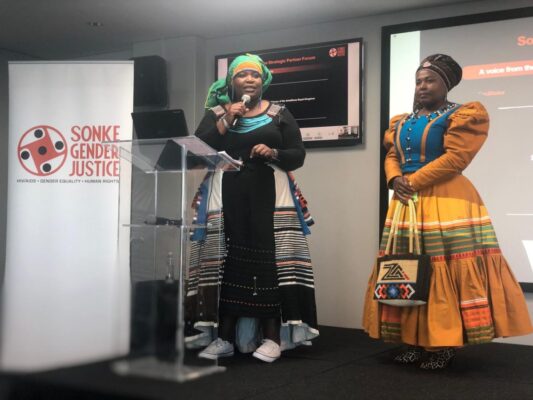
Sonke recently brought together donors, implementing partners and private sector allies for a hybrid Strategic Partner Forum, on the 13th of June to reflect on the current donor funding landscape. The gathering took place at a critical time when the global political climate has become challenging, affecting especially the non-governmental organization sector.
Recent global shifts, including changes in United States foreign policy and budget allocations have led to cuts in USAID funding. These reductions have affected many international development and health initiatives, especially those focusing on gender justice, human rights, and HIV/AIDS prevention. Many civil society organizations that previously depended on USAID for core or project-specific funding are now facing serious financial instability. This has led to the closure of some organizations while others are undergoing restructuring to remain operational. Sonke is one of the affected organizations and had to shut down its operations of the Khutlo project in Lesotho, fully funded by USAID.
Acting chairperson of the Board Dr Mfanozelwe Shozi reflected on this ‘’We meet at a precarious moment for human rights and gender transformation. The emerging geopolitical developments signal a difficult road ahead. The prospect of a second Trump administration comes with challenges, particularly for issues related to Sexual and Reproductive Health Rights and gender justice. Again, countries that were once strong allies in advancing progressive policies are now embracing more conservative approaches, and this leads to the rollback of our hard-won gains in the sector.”

Presenting on the state of gender in Africa and the regional funding landscape, Dr Linda Ncube-Nkomo, Chief Executive Officer of the Nelson Mandela Children’s Fund, discussed the emerging trends, shifts in donor priorities, and funding gaps. “So, while investment and development assistance has increased in some areas, funding remains fragmented, unpredictable and uneven, particularly when it comes to Social Justice, Gender Equity and grassroots driven work,” she said.
“Gender and social justice remain underfunded despite global commitment funding, for gender equality and transformative justice. We’ve seen that less than one percent of gender focused international aid goes directly to women-led organizations in Africa. Short term project-based funding is what’s available, which comes with burdensome reporting requirements and a lack of flexible support that makes it difficult for organizations to build reserves that can enable them to continue doing the work when donor funding dries up,’’ Ncube-Nkomo adds.
Weighing in on some of the possible solutions for the challenging landscape, Nicky Le Roux, Senior Program Officer at Ford Foundation, reflected on the importance of core funding in ensuring organizational sustainability. “For us, flexible core funding is key as a basis for supporting organizations. We believe it empowers them to adapt, to innovate, and I think it hasn’t been even more critical than now when we’ve seen the funding landscape shifting,” she said.
A representative of one of Sonke’s implementing partners was the Amaxhosa Queen Vuyokazi Nonzuzo Sigcawu on behalf of the AmaXhosa Royal Kingdom. Sonke has partnered with the Kingdom on the Inkanyezi project funded by Global Affairs Canada, implemented in the Amathole district of the Eastern Cape. Representing the Queen, her Personal Assistant, Mbuyi Kasana, shared a perspective on the realities and the challenges faced by communities in the province.
“We are facing numerous cases of Gender-Based Violence in our community. We’ve dealt with heartbreaking incidents, including women being murdered by their partners, and others being ostracised by the community simply for speaking out against abuse.’’ Kasana lamented.
She said the Queen has had to intervene in some of the cases through the Queen’s Desk programme where they help survivors of GBV, as well as through the Boy Child Campaign, in which they engage young boys from eight years upwards to help them challenge harmful norms from an early age. She added that the Queen often encounters resistance from some chiefs and men in the community, making the work even more difficult.
“During one of the Inkanyezi project workshops Queen Sigcawu invited her fellow queens to attend, but participation was limited. Some attended on the first day, to never come back. This is possibly due to resistance from their husbands, who may have feared that the women would become more empowered, and so we ask for Sonke to engage more with men to change their mindsets,” she urged.

The forum also heard from the Co-executive director of Sonke, Heather Van Niekerk who shared the findings of the recent organizational donor survey. The survey reaffirmed Sonke’s position as a trusted and impactful partner. “100% of respondents rated Sonke’s impact as either “Good” or “Very Good”, with an average weighted score of 3.6 out of 4. For us, this indicates recognition of Sonke’s relevance and positioning as a leading actor in the gender justice and human rights space,” emphasized Van Niekerk. Moving forward, Sonke intends to regularly host the Strategic Partner Forum, to sustain relationships with its partners.


