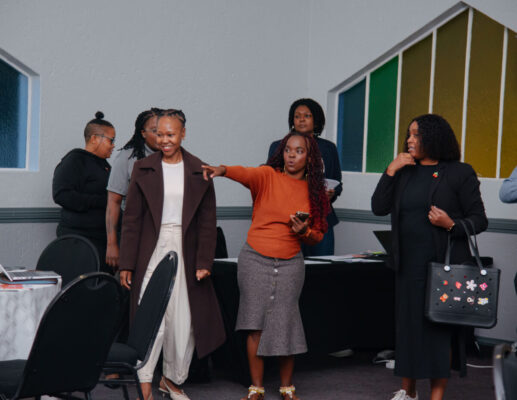
On 22 April 2025, civil society organisations, city officials, legal experts, and community advocates gathered at the Birchwood Hotel in Johannesburg for a high-level workshop aimed at discussing a policy framework addressing one of South Africa’s most urgent crises: Gender-Based Violence and Femicide (GBVF).
Convened by Sonke Gender Justice in partnership with UN Women and the Embassy of Ireland in South Africa, the workshop brought together approximately 70 stakeholders under the theme: “National Council on Gender-Based Violence and Femicide Act: Charting the Path to Reform. The convening shared findings from a legal review commissioned by Sonke Gender Justice on the National Council on Gender-Based Violence and Femicide (NCGBVF) Act and addressed the growing concerns around its ability to deliver meaningful accountability, coordination, and protection for survivors.
What emerged from the discussions was a shared understanding that while the Act marks an important legislative milestone, it is, however, not equipped to ensure the effective implementation of the National Strategic Plan on Gender -Based Violence and Femicide (NSP GBVF). In essence the Act is not fit for its purpose and needs to be amended to ensure it can effectively deliver on its mandate.
Sonke Gender Justice’s co-executive director, Bafana Khumalo, noted in his opening remarks that the issue of gender-based violence and femicide is a huge lot in our democratic short life.
Among the key concerns addressed by the legal review and raised during the workshop were:
- Limited authority, as the Act does not include binding duties requiring national departments, provinces or municipalities to align their plans, budgets or reporting cycles with the NSP GBVF
- Limited governance and institutional independence, as the board composition gives most of the voting power to government representatives. This departs from the NSP’s intended model, which proposed majority civil society representation to strengthen independence and credibility
- Weak coordination mechanisms across government departments and provinces, as provinces and municipalities are not required to establish GBVF structures or report to the Council
- Financing and resource inadequacy, as the Act does not secure dedicated or ring-fenced funding for the Council or a future GBVF Fund.
Participants warned that without structural reform, the Council risks becoming ineffective before it is fully operational. “Passing laws alone is not enough. We need action that works for the city, that works for the province as well as the country,” a participant noted during the discussion.
A recurring theme throughout the workshop was the need for a truly independent and adequately resourced National Council. Speakers stressed that the Council cannot effectively hold institutions accountable if it remains overly dependent on the same structures it is meant to oversee.
“The strengthening of the National Council on GBVF is not something we can do alone. The UN system is here together as a UN family represented in South Africa. But we ourselves cannot do this alone. It really requires the authority and accountability of government,” said a representative during the engagement, said Dr Hazel Gooding, UN Women Deputy Country Representative Director.
There were also strong calls for political will from the Presidency and for government to provide the operational environment necessary for the Council to function effectively. “We want to ensure that government provides the needed financial support, spending approvals and policy inputs to the National Council so that it has the requisite operating environment,” said Kayan Leung, Deputy Director at Lawyers for Human Rights.
Funding Remains a Major Challenge
One of the strongest interventions during the workshop focused on funding gaps within the national GBVF response. Participants argued that limited funding has created competition between organisations, weakening opportunities for collective action and collaboration.
“There is such limited funding, you often have people or organisations competing over this funding and not actually leveraging the collective power that they might have in the response by being able to work together,” said Hannah Wolpe, SRHR representative in the Parliament research unit. Several stakeholders called for the government to recognise GBVF as a national disaster that requires urgent and sustained investment.
Participants also emphasised the importance of collective organising and encouraged civil society groups to join ongoing advocacy efforts such as the Call to Action and Not Fit for Purpose campaigns. While the workshop concluded with a clearer roadmap for reform advocacy, participants acknowledged that the real work lies ahead. For many in attendance, the day represented more than a policy discussion. It was a reminder that survivors of GBVF need institutions that are independent, adequately funded, and capable of delivering justice and accountability.